Who Lacks ID and Proof of Citizenship in California?
The debate over voter ID and proof of citizenship laws continues to grow louder across the country. But in California, some basic questions have been lost in the noise: How many Californians actually have those documents? And who doesn’t?
VoteRiders partnered with the University of Maryland’s Center for Democracy and Civic Engagement (CDCE) to find out.
The result is the first representative survey of voting-age California citizens focused on voter ID access, barriers, and knowledge.
Research Highlights
CDCE’s analysis of the survey results reveals significant gaps in access to key identity documents, real barriers to obtaining them, and widespread voter confusion.
Details Determine Impact
Not all voter ID or “proof of citizenship” laws are the same.
Which documents qualify, whether a photo is required, if expired IDs count, how closely a name or address must match, and what options exist for voters who can’t comply – all of these choices change who is impacted.
How many Californians would be affected by any given voter ID requirement depends on its details. But the survey results make it clear that narrow requirements could exclude significantly more voters than flexible ones.
Who is Most Affected?
Access to ID and citizenship documents isn’t equally distributed across California’s population – and the communities with the least access are often the ones already navigating the most obstacles in civic and economic life.
The survey finds significant gaps in documentation across demographic groups. These gaps are widespread, but vary in scale.
Gaps in access to a driver’s license provide a clear example:
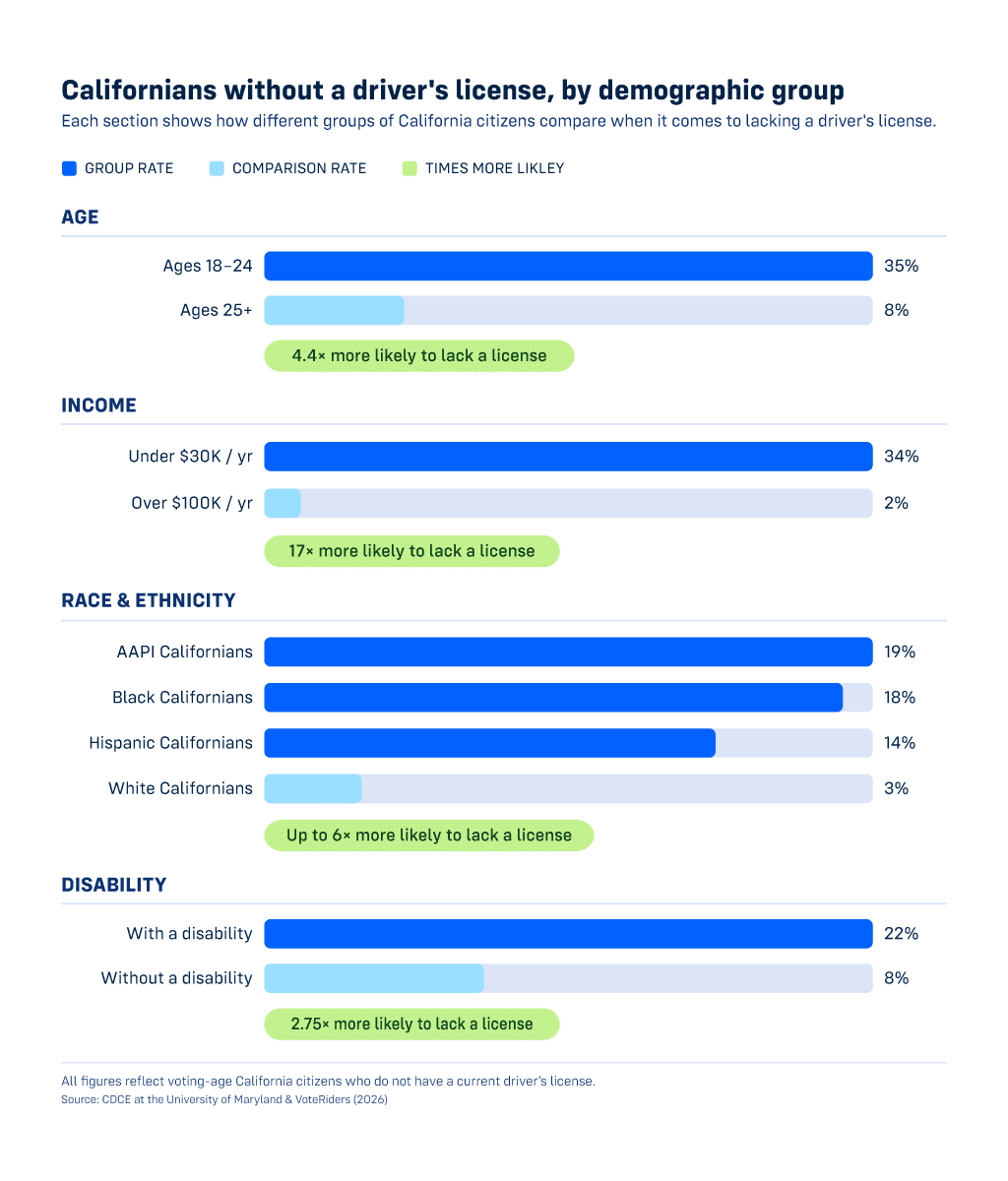
The income gap extends beyond driver’s licenses: nearly half of Californians earning under $30,000 annually also lack a passport, leaving them with few fallback options.
These gaps don’t affect everyone the same way, and neither would any new voter ID or documentary proof of citizenship requirements. How these laws are designed determines which citizens have options and which face serious barriers to casting a ballot that counts.
Millions Lack a Driver’s License
A majority of adult California citizens have an unexpired California driver’s license that lists their correct name and address.
But roughly one in five Californians is in a more complicated position – holding licenses that are expired, outdated, or issued in another state. That amounts to 4.5 million voting-age citizens.
These distinctions matter because they could determine which Californians would meet specific voter ID requirements. A law that accepts outdated addresses covers a very different population than one requiring an exact, current match.
The report shows how millions of citizens fall in or out of compliance depending on potential policy details:
- Not requiring a current address would allow nearly 1.8 million more Californians to use their license
- Accepting out-of-state licenses would cover another 650,000
- Allowing expired California licenses would add 630,00 more
Even under the most flexible scenario, roughly 2.7 million Californians without any driver’s license would need to rely on other documents.
For the 650,000+ Californians who have neither a driver’s license nor a state ID card, an expansive list of accepted IDs or an alternative option would matter most.
Proof of Citizenship Adds Difficulty
An increasing number of states are adding a new requirement to voter registration: documentary proof of citizenship.
Documents that prove United States citizenship – like a US birth certificate, passport, naturalization certificate, or certificate of citizenship – are different from the IDs Californians generally carry. And millions don’t have easy access to them.
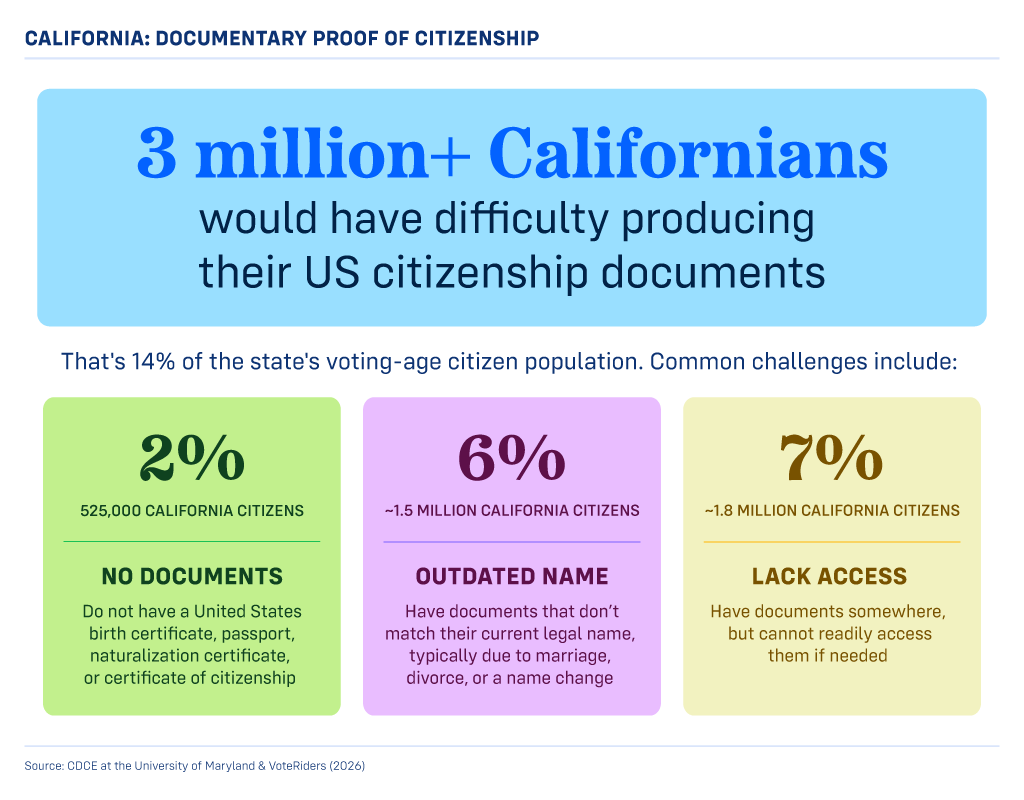 The survey shows real gaps in access to citizenship documents across every demographic group, but the specific challenges vary significantly by community.
Women are far more likely than men to have citizenship documents that no longer reflect their legal name. Black Californians are most likely to struggle accessing documents they technically have, while other communities of color and lower-income Californians are more likely to have no documents at all.
No group is unaffected, and no single policy design can address them all equally.
Barriers to Access
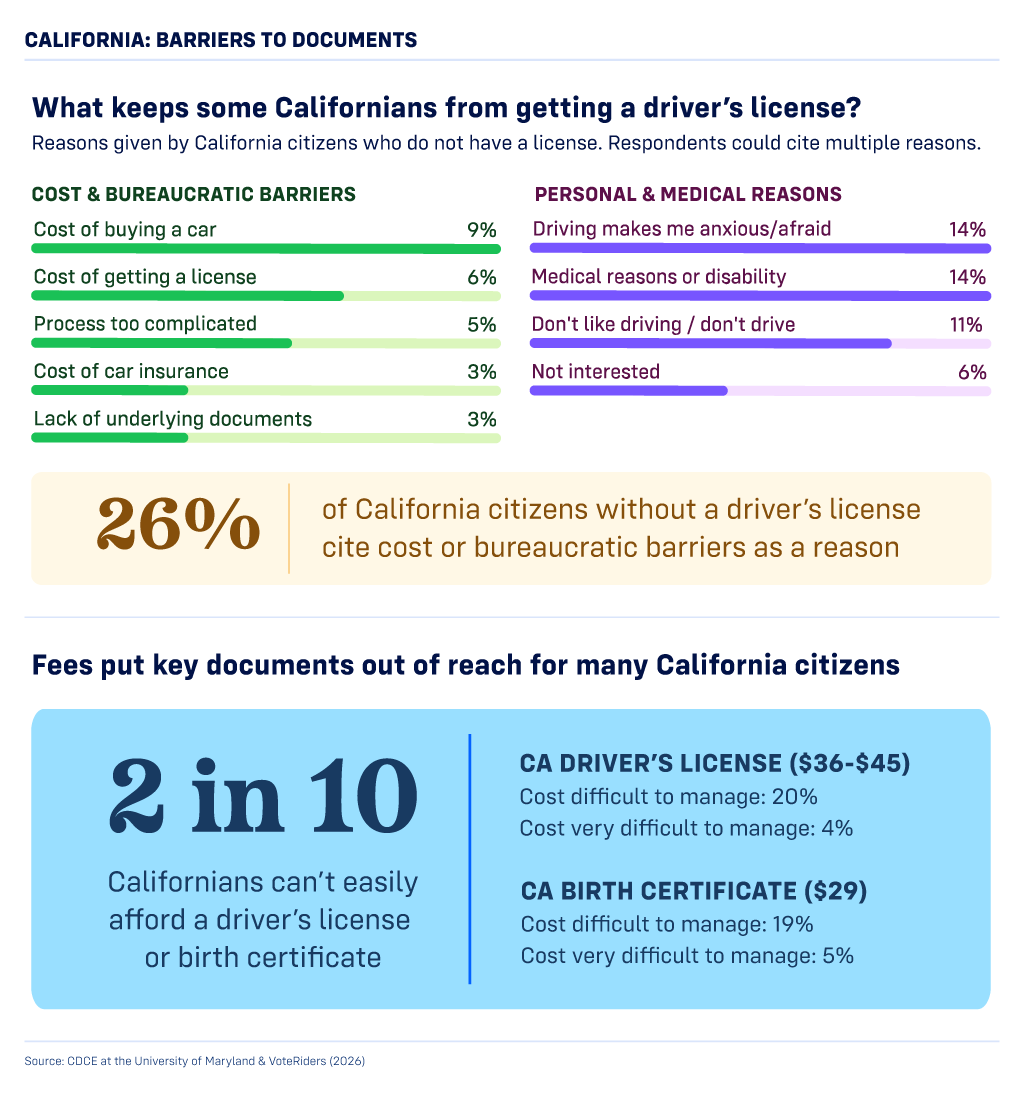
Across the board, survey respondents expressed frustration with the process of obtaining and replacing identity documents.
Cost and wait times present significant hurdles for millions of Californians. Many simply can’t afford to invest the time and money required to navigate the state’s document bureaucracy.
Confusion is Widespread
The survey also tested whether Californians know the state’s current voter ID rules. The results are striking.
California currently does not require a photo ID at the polls. Yet 27% of the state’s adult citizens believe it does, and another 37% are unsure. This means fewer than 4 in 10 Californians are clear on the current rules.
Confusion about voting requirements is itself a barrier to participation. The scale of existing confusion makes it clear that voter education isn’t a secondary concern. It’s a central implementation challenge.
This challenge would grow with any new requirements, regardless of what they entail.
About Our Research
This California survey was conducted by SSRS on behalf of VoteRiders and the Center for Democracy and Civic Engagement (CDCE) at the University of Maryland. It builds on VoteRiders and CDCE’s national studies and our state surveys in Georgia and Texas.
The survey was fielded in November and December 2025, with 1,561 adult US citizens residing in California. The sample includes oversamples of 18–24-year-olds, Black respondents, and naturalized citizens. All results are weighted. Population estimates are based on the US Census Current Population Survey 2024 data. The survey was available in English and Spanish. CDCE conducted all data analysis. Full methodology and topline results are available on the CDCE website.
About CDCE: The University of Maryland’s Center for Democracy and Civic Engagement conducts nonpartisan research on elections, civic participation, and democratic governance. Contact CDCE.
About VoteRiders: VoteRiders is the country’s leading organization focused on nonpartisan voter ID education and assistance. Contact VoteRiders.
